Tests
Overview
Use the IQ System Tests page to run built-in diagnostic and communication tests. These tests help you verify connectivity, hardware operation, communication paths, signal strength, and power input.
Use this page to:
- Test a new panel installation.
- Troubleshoot communication or hardware issues.
- Test wireless device connectivity.
- Confirm power and network status.
Before you begin
Preconditions
- Confirm that the IQ Panel is powered on and has completed startup.
- Confirm that the network interfaces required for testing are enabled and configured.
- Pair wireless devices with the panel before you run wireless communication tests.
Important limitations
warning
- Available tests may vary depending on panel model and installed hardware.
- Some tests require an active internet, cellular, or wireless connection.
- Running tests does not automatically correct detected issues.
Page layout
System Tests screen
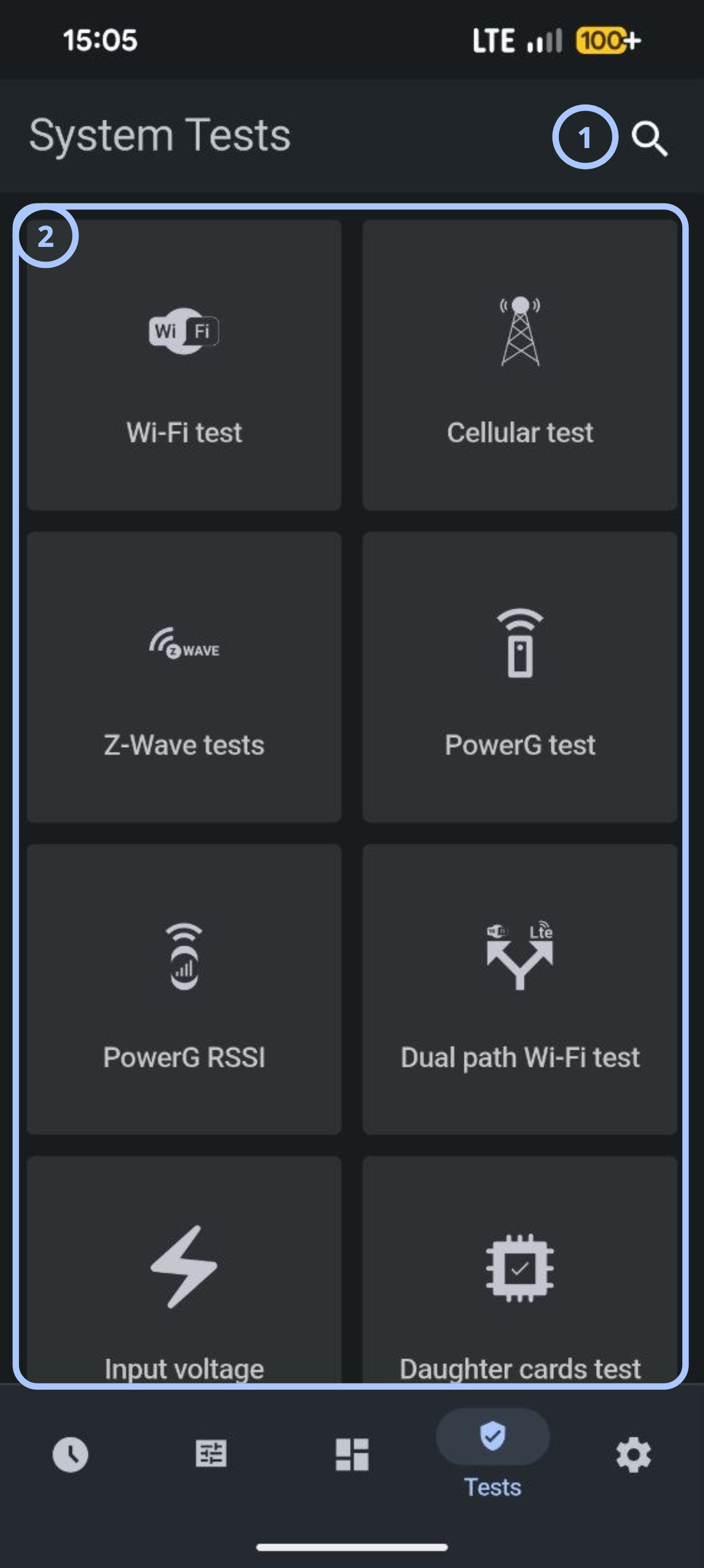
| Callout | UI element | Description | When to use |
|---|---|---|---|
| 1 | Search | Opens the search function for locating available tests. | Use when the list contains multiple test options. |
| 2 | Test tiles | Displays available diagnostic tests. Select a tile to open and run the corresponding test. | Use to access a specific diagnostic tool. |
Test reference
| Test | Description | When to use |
|---|---|---|
| Wi-Fi test | Tests the panel's Wi-Fi connectivity and communication status. | Verify Wi-Fi connectivity, troubleshoot network communication, or confirm access point availability. |
| Cellular test | Tests the panel's cellular communication path. | Verify cellular connectivity or troubleshoot cellular communication. |
| Z-Wave tests | Runs diagnostics for Z-Wave communication and connected devices. | Verify Z-Wave network health, troubleshoot automation devices, or confirm device communication. |
| PowerG devices test | Tests PowerG wireless sensor communication. | Verify PowerG connectivity, validate sensor operation, or troubleshoot communication failures. |
| PowerG RSSI | Displays received signal strength indicator (RSSI) measurements for PowerG devices. | Evaluate signal quality, assess device placement, or troubleshoot intermittent communication. |
| Dual path Wi-Fi test | Verifies Wi-Fi and alternate communication paths supported by the panel. | Validate communication redundancy, reporting-path availability, or failover configuration. |
| Input voltage | Displays or tests the power input supplied to the panel. | Verify power stability, troubleshoot power issues, or confirm voltage during installation. |
| Daughter cards test | Tests installed daughter cards and expansion hardware. | Verify module detection and expansion-card operation, or troubleshoot expansion hardware. |
| Panel test | Runs a general panel diagnostic procedure. | Validate panel operation during installation or maintenance. |
How to use this page
Run a diagnostic test
- Open the Tests page.
- Locate the required test tile.
- Select the required test.
- Wait for the panel to execute the diagnostic procedure.
- Review the displayed test results.
Verify Wi-Fi communication
- Open Tests.
- Select Wi-Fi test.
- Start the test if prompted.
- Review the connectivity results.
Verify cellular communication
- Open Tests.
- Select Cellular test.
- Run the diagnostic.
- Review the returned status.
Check PowerG signal strength
- Open Tests.
- Select PowerG RSSI.
- Review the signal measurements.
- Reposition devices if signal quality is insufficient.
note
Signal quality requirements depend on device type and installation environment.
Verify panel power
- Open Tests.
- Select Input voltage.
- Review the displayed measurements.
Tips
tip
- Use PowerG RSSI measurements before permanently mounting wireless devices.
- Review power input status when troubleshooting unexpected panel behavior.
Troubleshooting
Wi-Fi test fails
Possible causes:
- Incorrect network configuration.
- Internet access is unavailable.
- Signal strength is too low.
What to try:
- Verify Wi-Fi settings.
- Check signal strength.
- Run the test again.
Cellular test fails
Possible causes:
- Poor cellular coverage.
- Cellular service is unavailable.
- The communication module is unavailable or not configured correctly.
What to try:
- Check cellular signal quality.
- Verify service activation.
- Confirm that the cellular communication module is available.
- Run the test again.
- If the test still fails, contact your administrator or service provider.
PowerG RSSI reports weak signal
Possible causes:
- The device is too far from the panel.
- Interference from surrounding equipment.
What to try:
- Move the device closer to the panel.
- Retest signal quality.
Daughter cards test reports failure
Possible causes:
- Daughter card is not installed correctly.
- Hardware is unsupported or defective.
- Communication with the module failed.
What to try:
- Verify the module installation.
- Confirm hardware compatibility.
- Re-run the diagnostic test.
- Replace faulty hardware if necessary.
Input voltage outside expected range
Possible causes
- The power supply is unavailable or unstable.
- A wiring connection is loose or incorrect.
- External power was interrupted.
What to try:
- Verify the power source.
- Inspect wiring connections.
- Confirm power supply specifications.
- Repeat the voltage check.
Related pages
See also
Was this page helpful?