Audit log
Overview
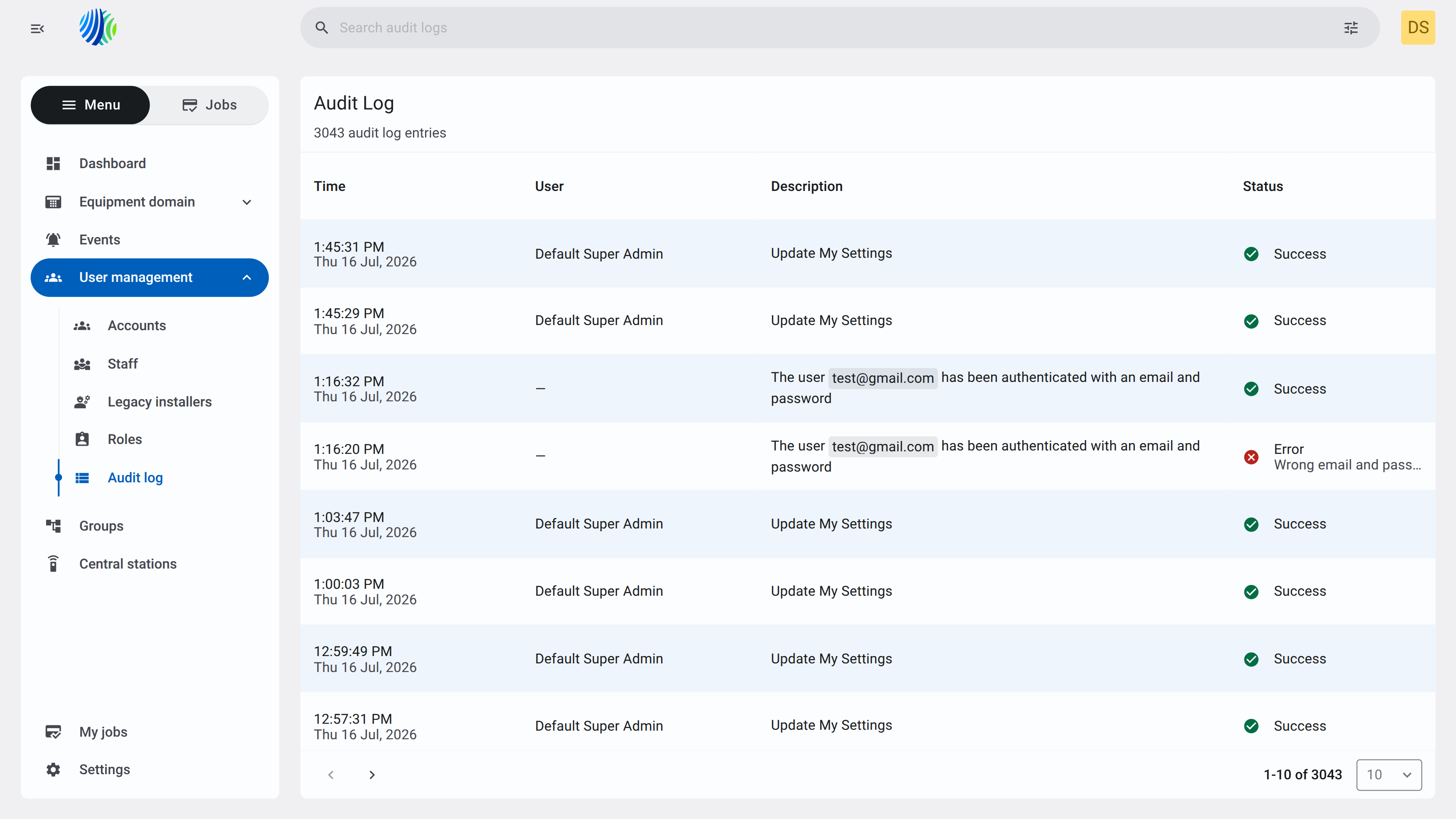
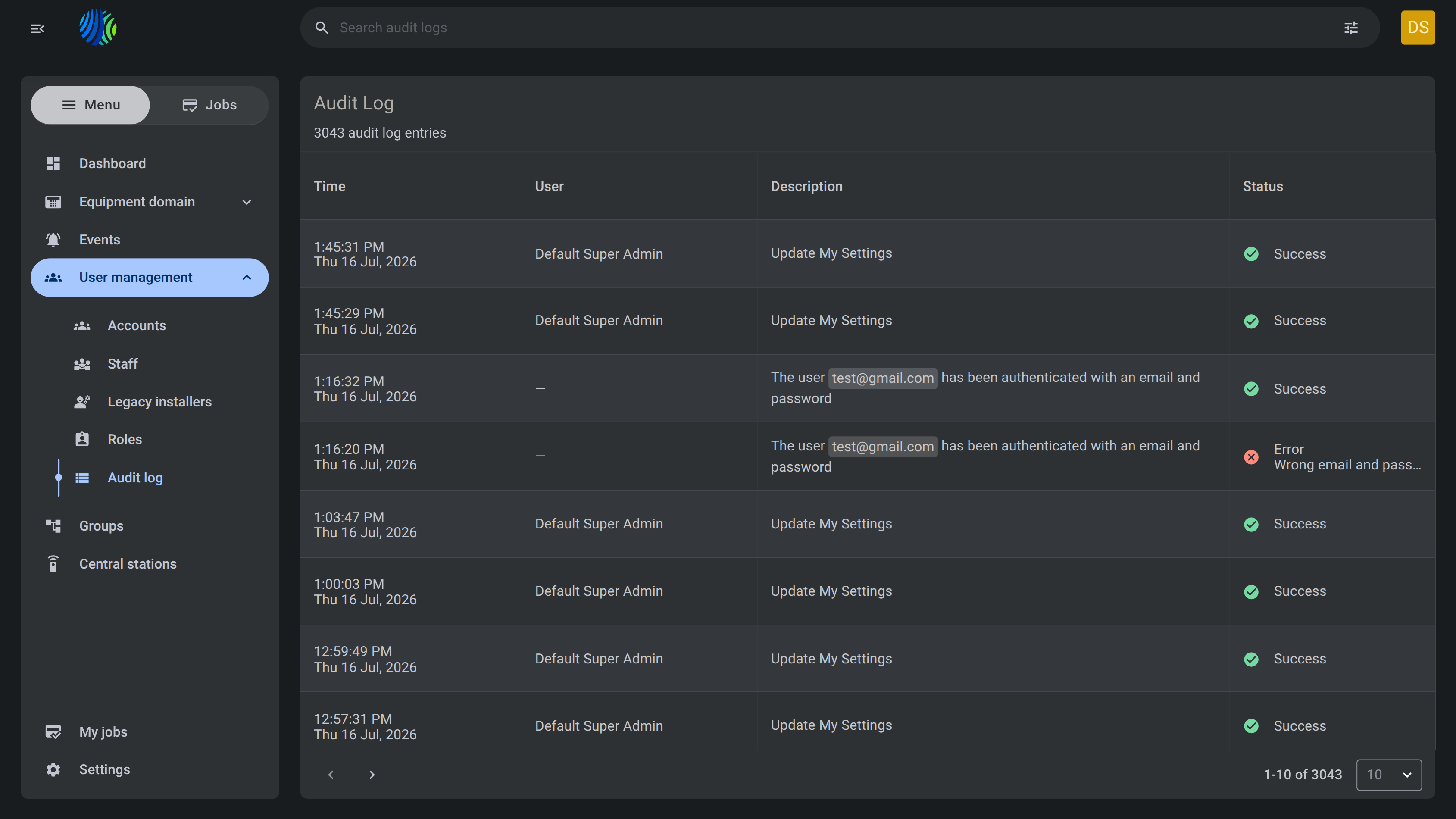
The Audit log page is used to review user actions recorded in PowerManage.
Use this page to:
- Review actions made by users.
- Check when an action was made.
- Identify the user who made an action.
- Review the detailed action description.
- Check whether an action completed successfully or with an error.
- Navigate through Audit log entries.
Before you begin
Required permissions
- You must have permission to view the Audit log page.
- Your role and assigned groups can affect which Audit log entries are visible.
info
Access to the Audit log page is controlled by the role permission group named Audit log.
Preconditions
- Audit log entries must exist before the grid can show data.
Dependencies
- The Audit log entries grid depends on recorded user actions.
- The User column depends on available user information.
- Pagination depends on the number of available Audit log entries.
Important limitations
warning
- If no Audit log entries are available, the grid can appear empty.
Page layout
Page header
The page header identifies the page and shows the number of available Audit log entries.


| Callout | UI element | Description | When to use |
|---|---|---|---|
| 1 | Page title | Shows the current page name: Audit log. | Use to confirm that you are on the Audit log page. |
| 2 | Audit log entries count | Shows the total number of Audit log entries, for example, 1285 Audit log entries. | Use to understand how many Audit log entries are available. |
Audit log entries grid
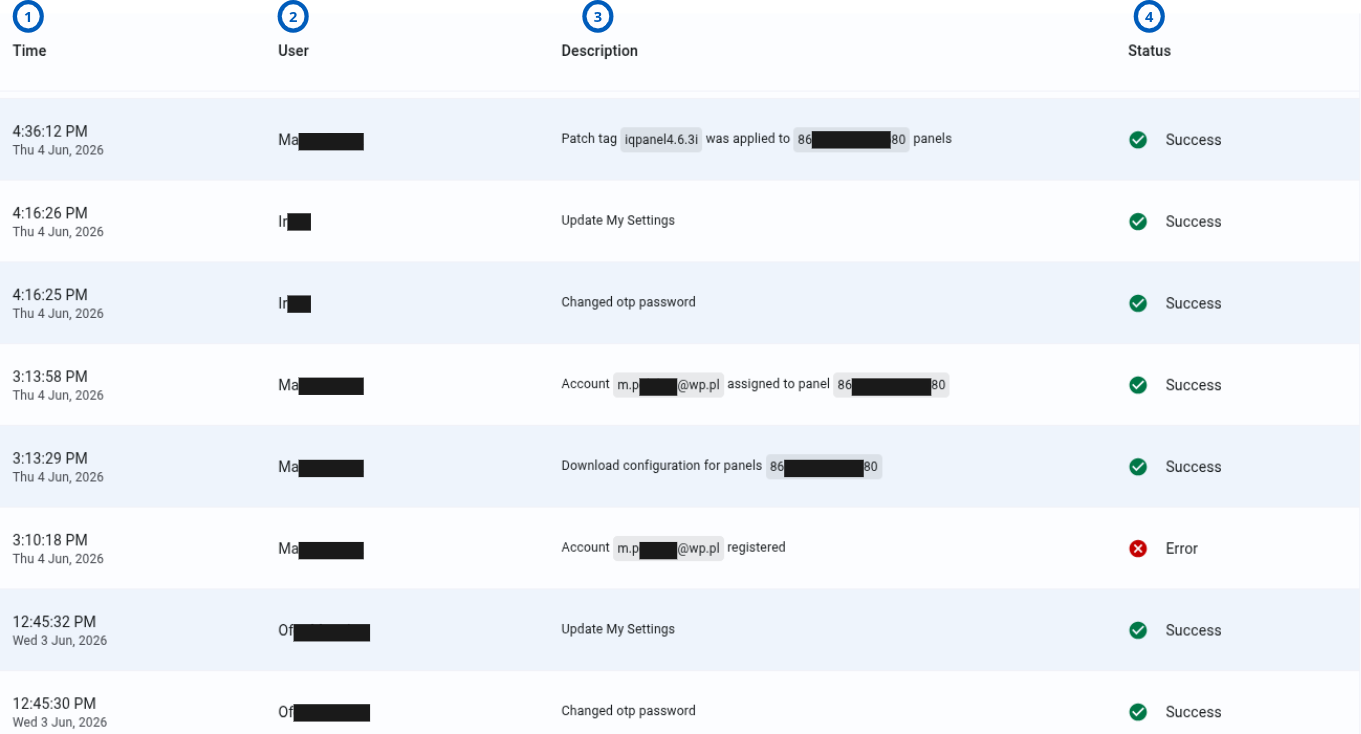
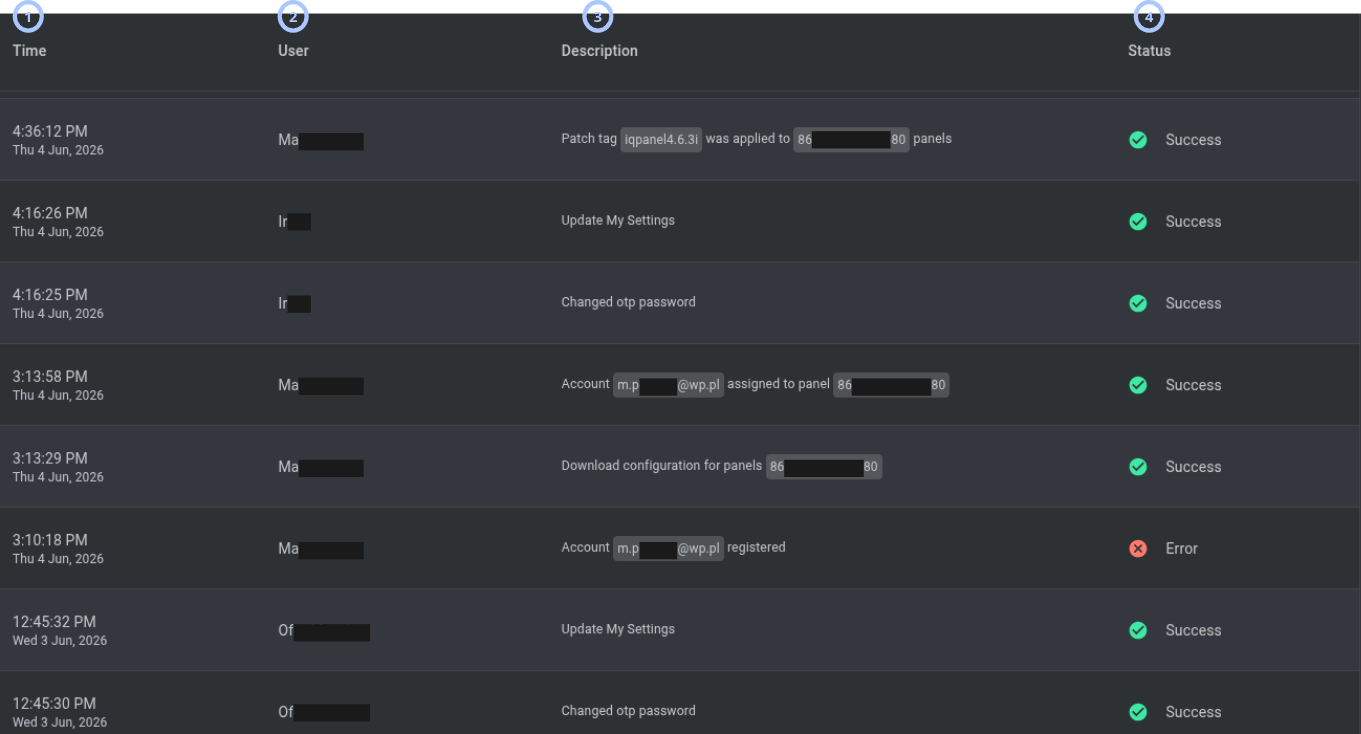
The Audit log entries grid appears under the page header. The grid lists Audit log entries and key details for each action.
| Callout | UI element | Description | When to use |
|---|---|---|---|
| 1 | Time column | Shows the time and date when the Audit log entry was created. The value is read-only and is set when the Audit log entry is created. Date and time format example: 12:08:58 PM Tue 5 May, 2026. | Use to understand when the action occurred. |
| 2 | User column | Shows the user who made the action. The value is read-only, uses an existing user name, and is set by the system. | Use to identify who performed the action. |
| 3 | Description column | Shows a detailed, read-only, system-generated description of the action, for example, Changed otp password. | Use to understand what changed or what operation was performed. |
| 4 | Status column | Shows the read-only, system-generated result of the action. Accepted values are Success and Error. Success means the action completed successfully. Error means the action did not complete successfully. | Use to check whether the action ended with Success or Error. |
Pagination controls
Pagination controls appear at the bottom of the Audit log entries grid.


| Callout | UI element | Description | When to use |
|---|---|---|---|
| 1 | Previous and next arrows | Shows left and right arrows, such as < and >, to move between pages. | Use when the Audit log entries list has more records than the current page can show. |
| 2 | Range indicator | Shows the current visible range and total number of Audit log entries, for example, 1-15 of 25. The value is read-only, system-generated, and updates when you change page or page size. | Use to understand where you are in the Audit log entries list. |
| 3 | Entries per page selector | Controls how many Audit log entries appear on one page. Available values are 10, 15, 50, 100, and 200. The default value is 15. | Use to show fewer or more Audit log entries in the grid. |
How to use this page
Review Audit log entries
Goal:
- Review user actions and their results.
Steps:
- Open the Audit log page.
- Review the Audit log entries count under the page title.
- Review the Time column to check when an action occurred.
- Review the User column to identify who made the action.
- Review the Description column to understand what action was performed.
- Review the Status column to check whether the action ended with Success or Error.
Expected result:
- You can identify the action, the user who made the action, the time of the action, and the action result.
Change the number of Audit log entries shown on a page
Goal:
- Change how many Audit log entries appear in the grid.
Steps:
- Go to the bottom-right area of the Audit log entries grid.
- Open the entries per page selector.
- Select one of the available values:
- 10
- 15
- 50
- 100
- 200
Expected result:
- The grid updates to show the selected number of Audit log entries per page.
- The range indicator updates.
Move between Audit log pages
Goal:
- Navigate through multiple pages of Audit log entries.
Steps:
- Go to the bottom-left area of the Audit log entries grid.
- Select the next arrow to move forward.
- Select the previous arrow to move back.
- Review the range indicator, for example, 1-15 of 25.
Expected result:
- The grid shows the selected page of Audit log entries.
- The range indicator updates.
Tips
tip
- Use the Time column to find actions made during a specific period.
- Use the User column to identify who made an action.
- Use the Description column to understand what was changed or attempted.
- Use the Status column to find actions that ended with Error.
- Increase the entries per page value when reviewing many Audit log entries.
Troubleshooting
Audit log entries are not visible
Possible causes
- No Audit log entries are available.
- You do not have permission to view the Audit log page.
- Your role is limited to groups with no related Audit log entries.
What to do
- Confirm that Audit log entries exist.
- Confirm that your role has permission to view the Audit log page.
- Contact an administrator if the grid remains empty.
The expected Audit log entry is not visible
Possible causes
- The Audit log entry is on another page.
- The entries per page value is too small.
What to do
- Use the pagination arrows to move between pages.
- Increase the entries per page value.
Pagination does not show the expected entries
Possible causes
- You are viewing a different page in the list.
- The entries per page value limits how many entries appear.
What to do
- Review the range indicator.
- Use the previous and next arrows to move between pages.
- Change the entries per page value if you need to show more entries.
Related pages
Was this page helpful?