Roles
Overview
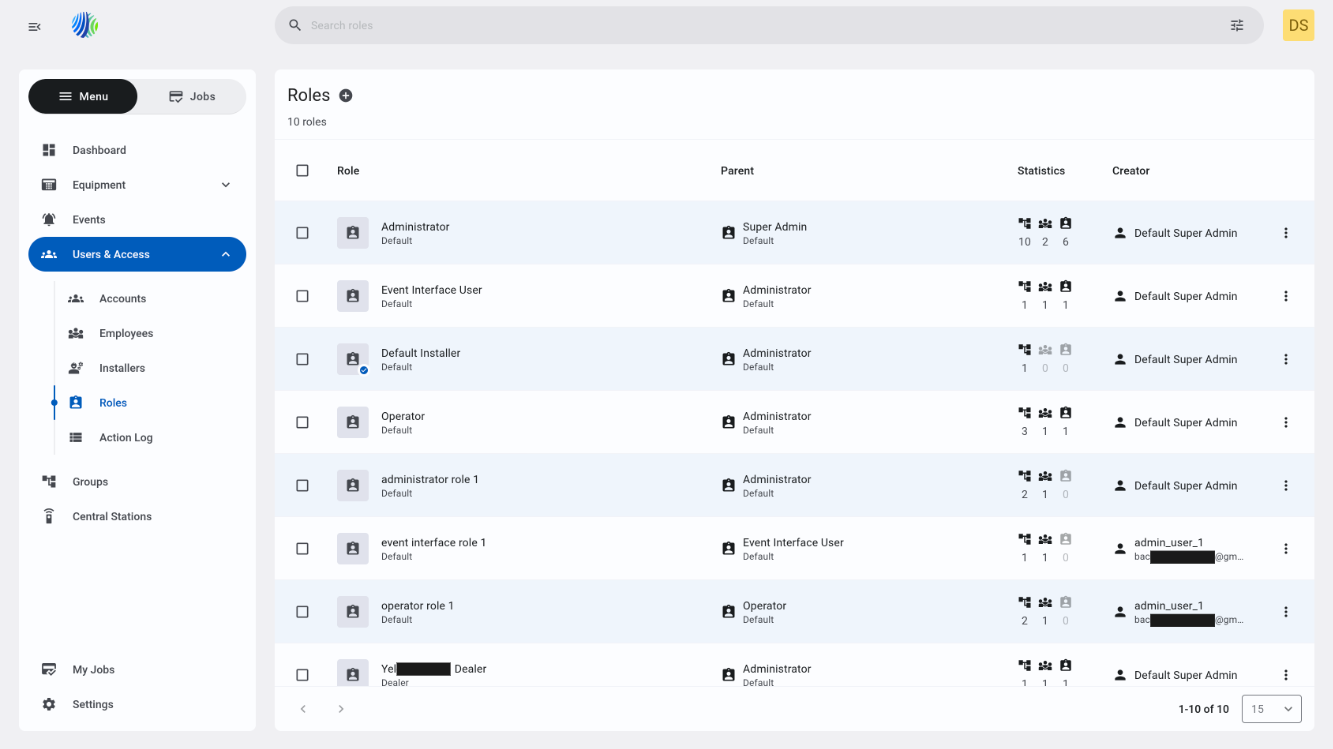
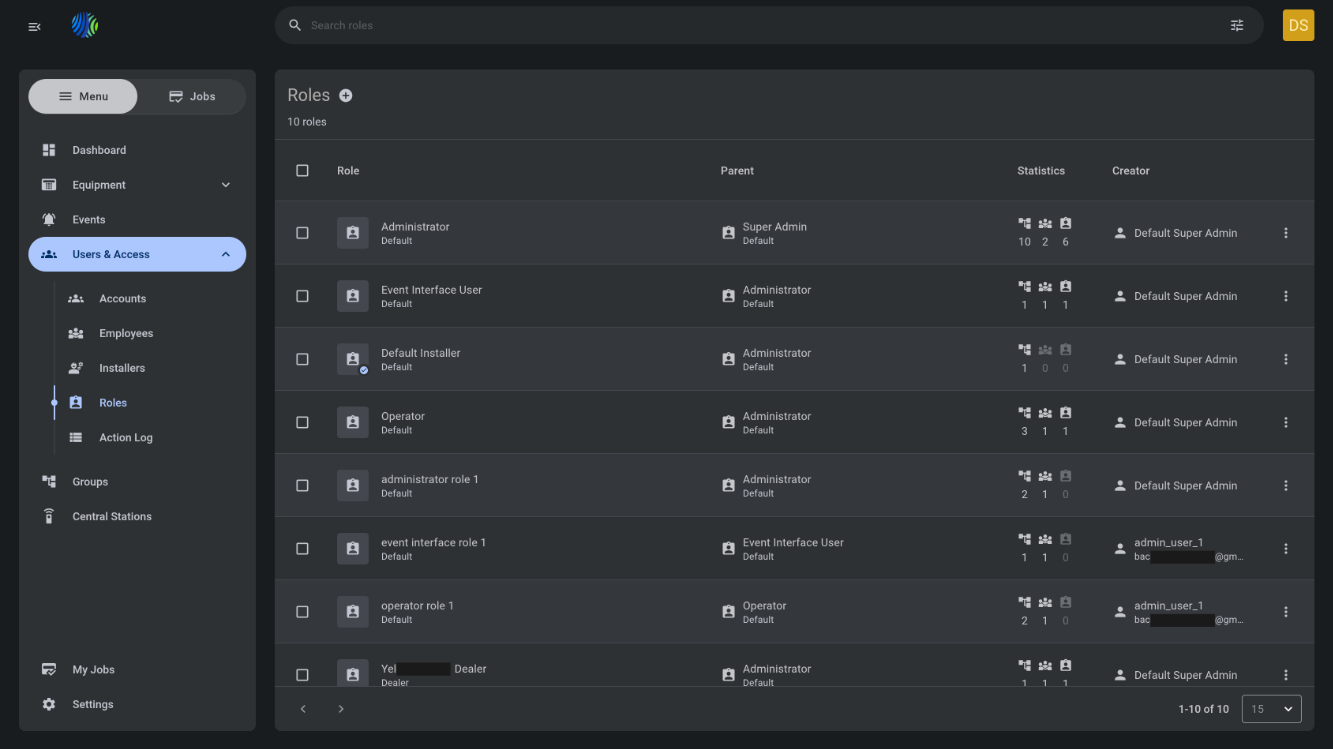
The Roles page is used to manage role-based access in the system. Use this page to:
- Create roles and assign them to a parent role.
- Assign one or more groups to a role.
- Review role hierarchy, assigned groups, assigned employees, and child roles.
- Edit role details and permissions.
- Set the default role used for self-registration.
- Remove roles that are no longer needed.
This page helps administrators control which users can access product areas and which actions they can perform.
Before you begin
Required permissions
- You must have permission to view roles.
- You must have permission to add roles.
- You must have permission to edit roles.
- You must have permission to remove roles.
- You must have permission to view role permissions.
- You must have permission to edit role permissions.
Access to the Roles page and role permission settings is controlled by the role permission group named Roles.
Preconditions
- At least one parent role must exist before you can create a role that belongs to another role.
- Groups must exist before they can be assigned to a role.
- To change self-registration settings, the system must support self-registration.
Dependencies
- Role access depends on the permissions enabled for the role.
- Group visibility and assignment depend on existing groups in the system.
- Child role relationships depend on the selected parent role.
- Self-registration depends on the configured registration mode and default role.
Important limitations
- Removing a role is permanent and cannot be undone.
- A role cannot be removed while it has child roles or assigned employees.
- Changing permissions can immediately affect what users assigned to the role can view or do.
- Built-in roles can have predefined permission sets. Review permissions before making changes.
Page layout
Page header


The page header identifies the page, shows the role count, and provides the entry point for creating a role. The Remove bulk action appears after you select one or more roles in the grid.
| Callout | UI element | Description | When to use |
|---|---|---|---|
| 1 | Page title | Shows the current page name: Roles. | Use to confirm that you are on the role management page. |
| 2 | + add icon | Opens the Create role modal. | Use to create a role. |
| 3 | Roles count | Shows the number of roles currently listed, for example, 10 roles. | Use to confirm the total after creating or removing roles. |
| 4 | Remove button | Appears in the page header after you select one or more roles. | Use to remove selected roles when they are no longer needed. |
Roles grid
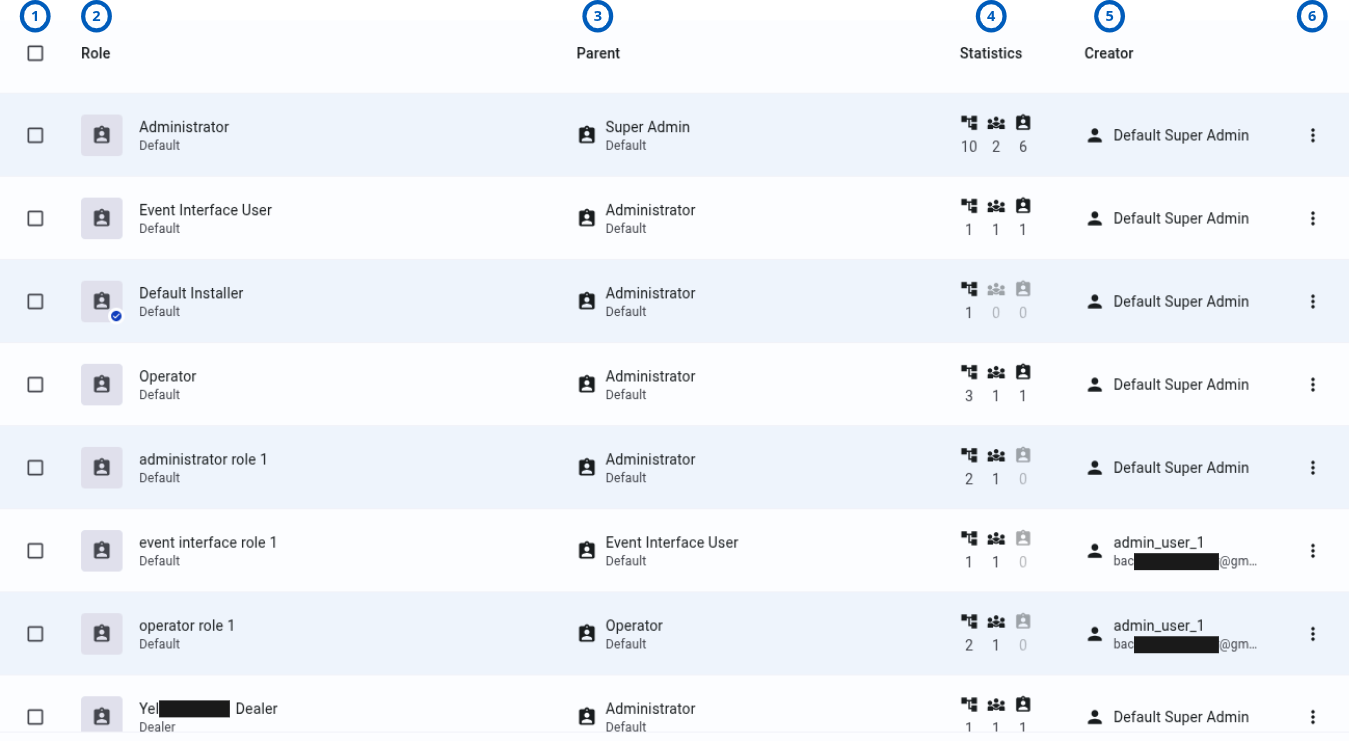
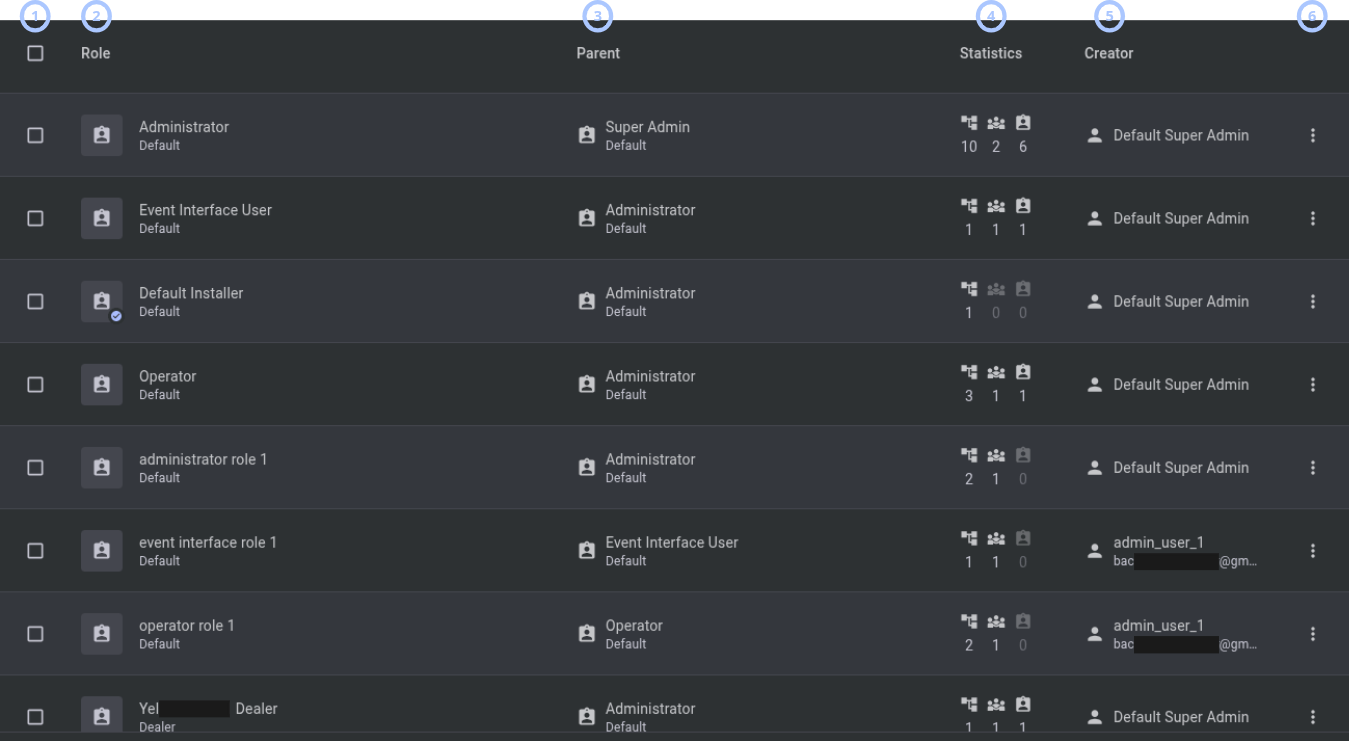
The roles grid lists roles and shows their hierarchy, statistics, creator, and available actions.
| Callout | UI element | Description | When to use |
|---|---|---|---|
| 1 | Checkbox | Selects one or more roles. | Use to show the bulk Remove action in the page header. |
| 2 | Role column | Shows the role name and role type. Role types can include Default, Dealer, and Installer. The default registration role is marked with a check icon. | Use to identify the role and confirm whether it is the default registration role. |
| 3 | Parent column | Shows the parent role for the role. | Use to understand the role hierarchy. |
| 4 | Statistics column | Shows counts for assigned groups, assigned employees, and child roles. | Use to review role usage before editing or removing a role. |
| 5 | Creator column | Shows the employee who created the role. | Use for audit and ownership review. |
| 6 | Row actions menu | Shows a three vertical dots menu for a specific role. | Use to edit the role, edit permissions, set the default registration role, or remove the role. |
Create role modal
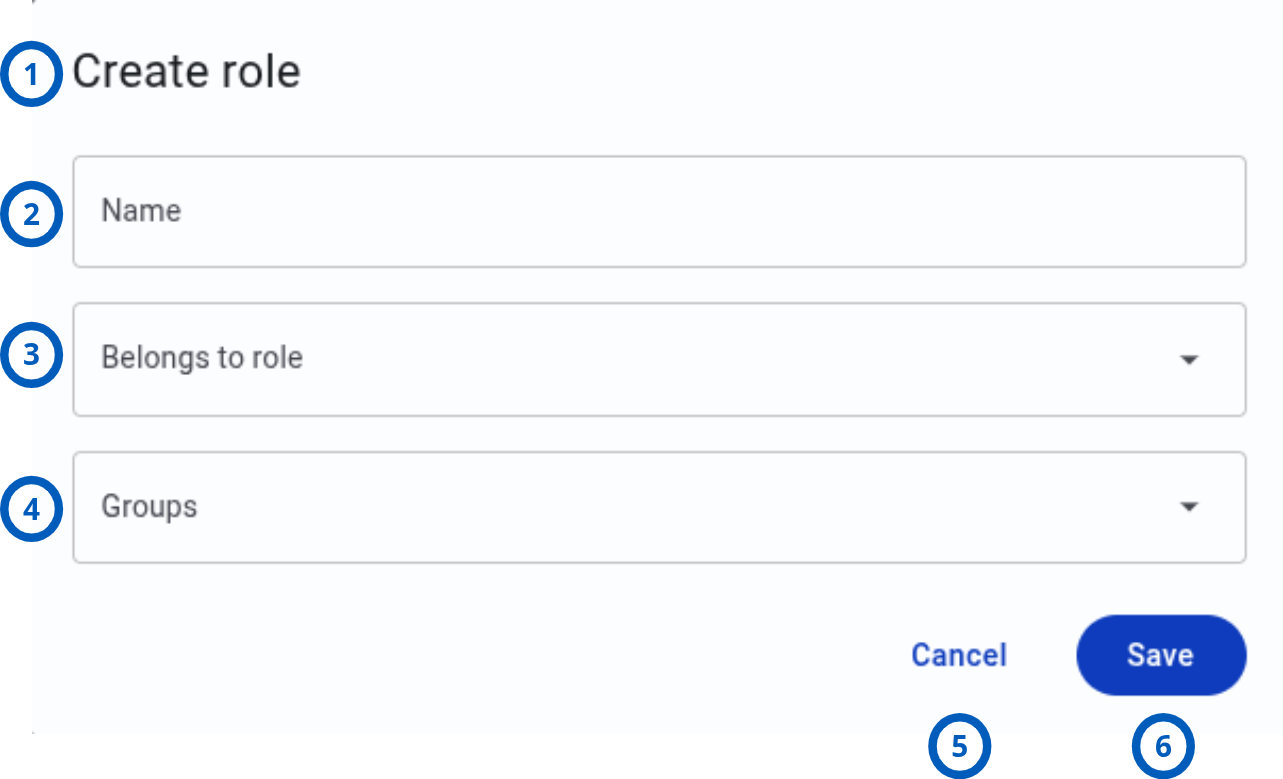
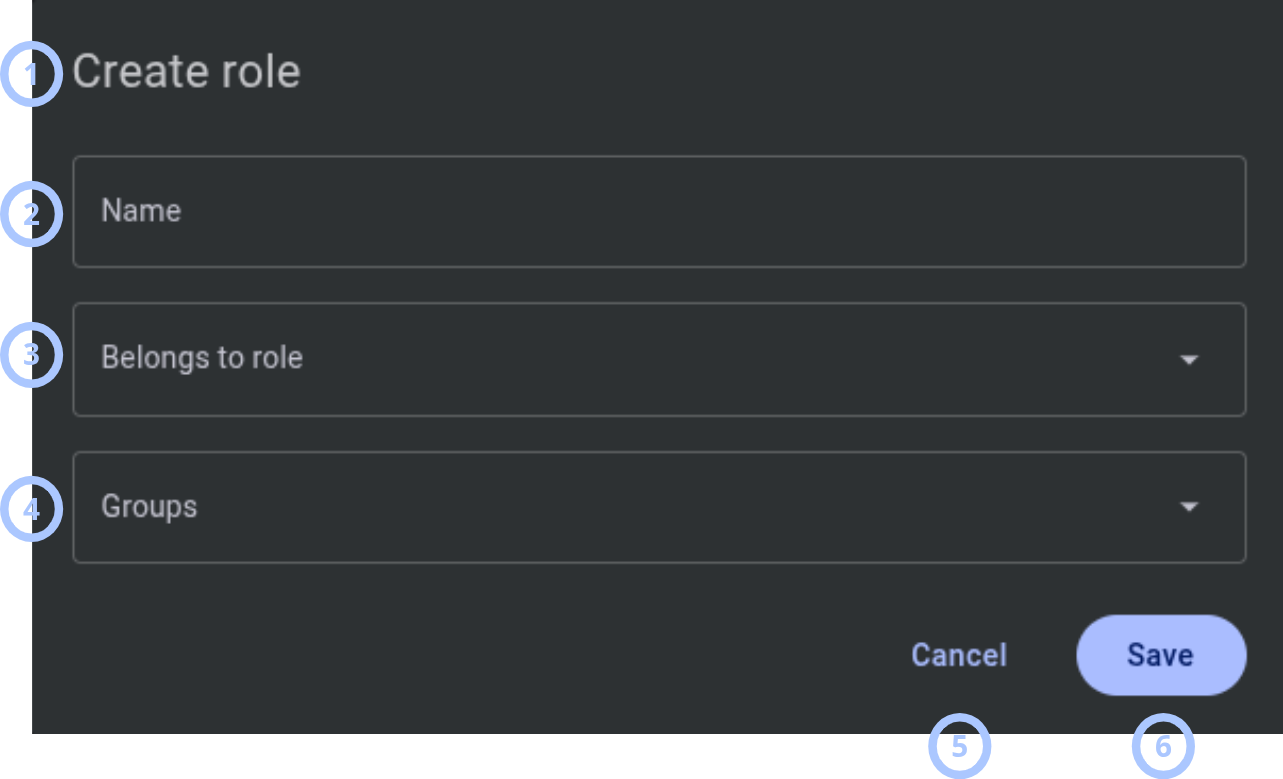
The Create role modal opens when you select the + add icon in the page header.
| Callout | UI element | Description | When to use |
|---|---|---|---|
| 1 | Modal title | Shows the modal name: Create role. | Use to confirm that you are creating a role. |
| 2 | Name field | Stores the role name. | Use to enter a clear role name. |
| 3 | Belongs to role dropdown | Sets the parent role for the new role. | Use to place the role in the role hierarchy. |
| 4 | Groups dropdown | Assigns one or more groups to the role. Multiple groups can be selected. | Use to define which groups are associated with the role. |
| 5 | Cancel button | Closes the modal without creating a role. | Use when you do not want to save changes. |
| 6 | Save button | Creates the role when all values are valid. | Use after you enter the required role information. |
Row actions menu
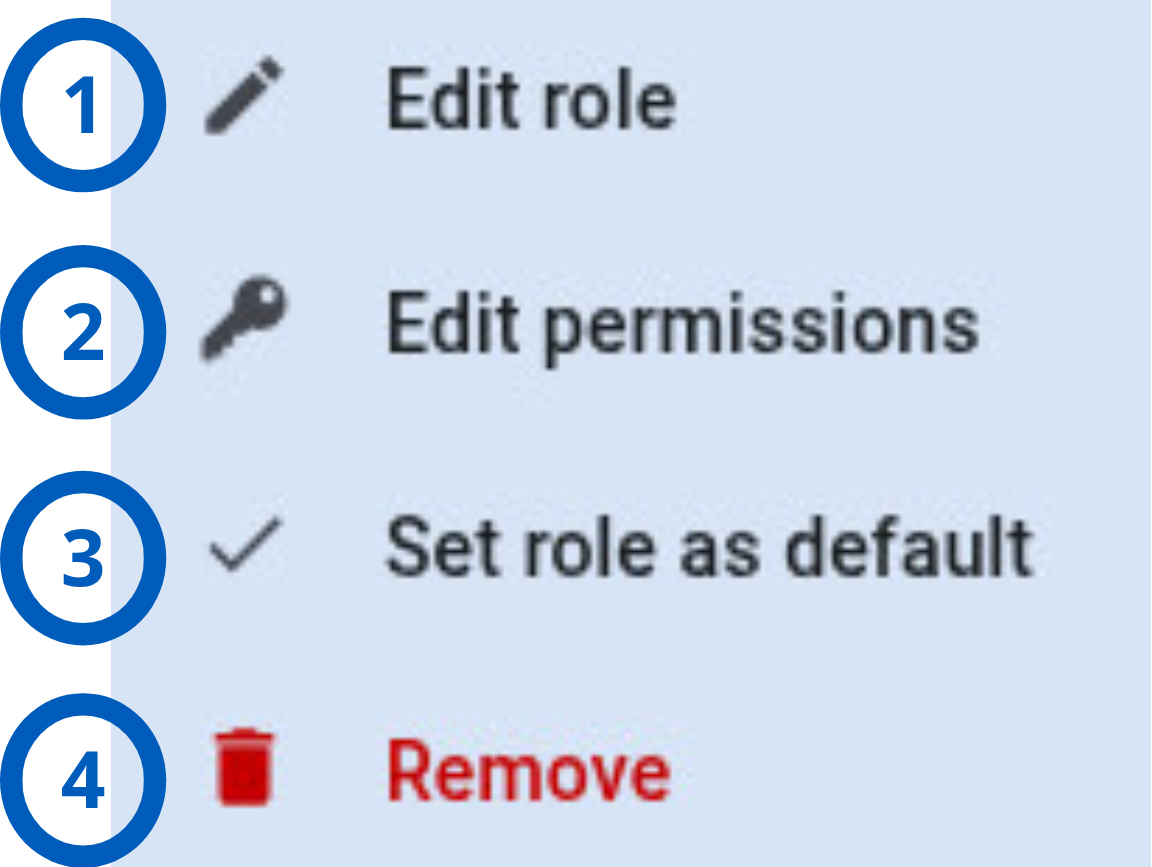
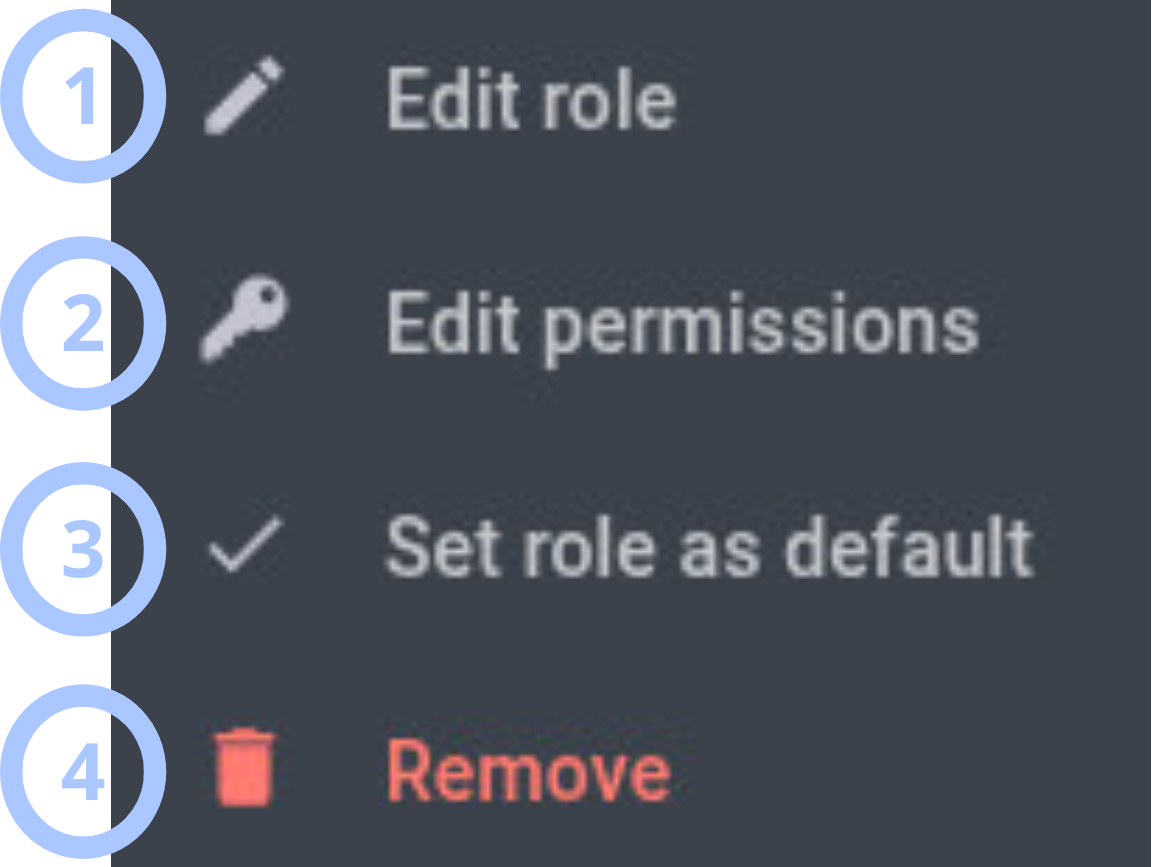
Each role row has a three vertical dots menu. The available actions depend on whether the role is set as the default role for registration.
| Callout | UI element | Description | When to use |
|---|---|---|---|
| 1 | Edit role | Opens the Edit role modal. | Use to change the role name or assigned groups. |
| 2 | Edit permissions | Opens the Edit role permissions modal. | Use to enable or disable permission groups and permissions for the role. |
| 3 | Set role as default | Opens the Edit self-registration settings modal. This action is available only when the role is not already set as the default registration role. | Use to set a role as the default role for registration. |
| 4 | Remove | Opens the Remove role modal or shows a warning if the role cannot be removed. | Use when the role is no longer needed. |
Edit role modal
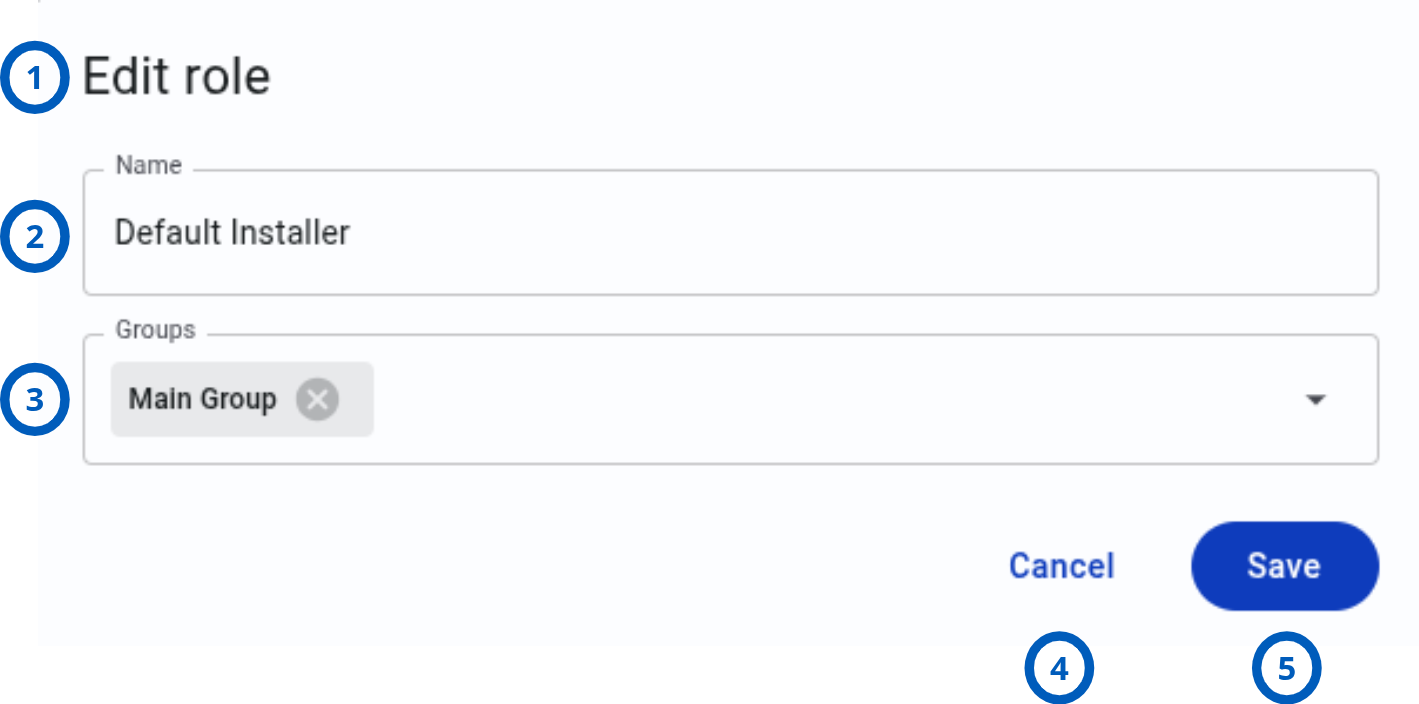
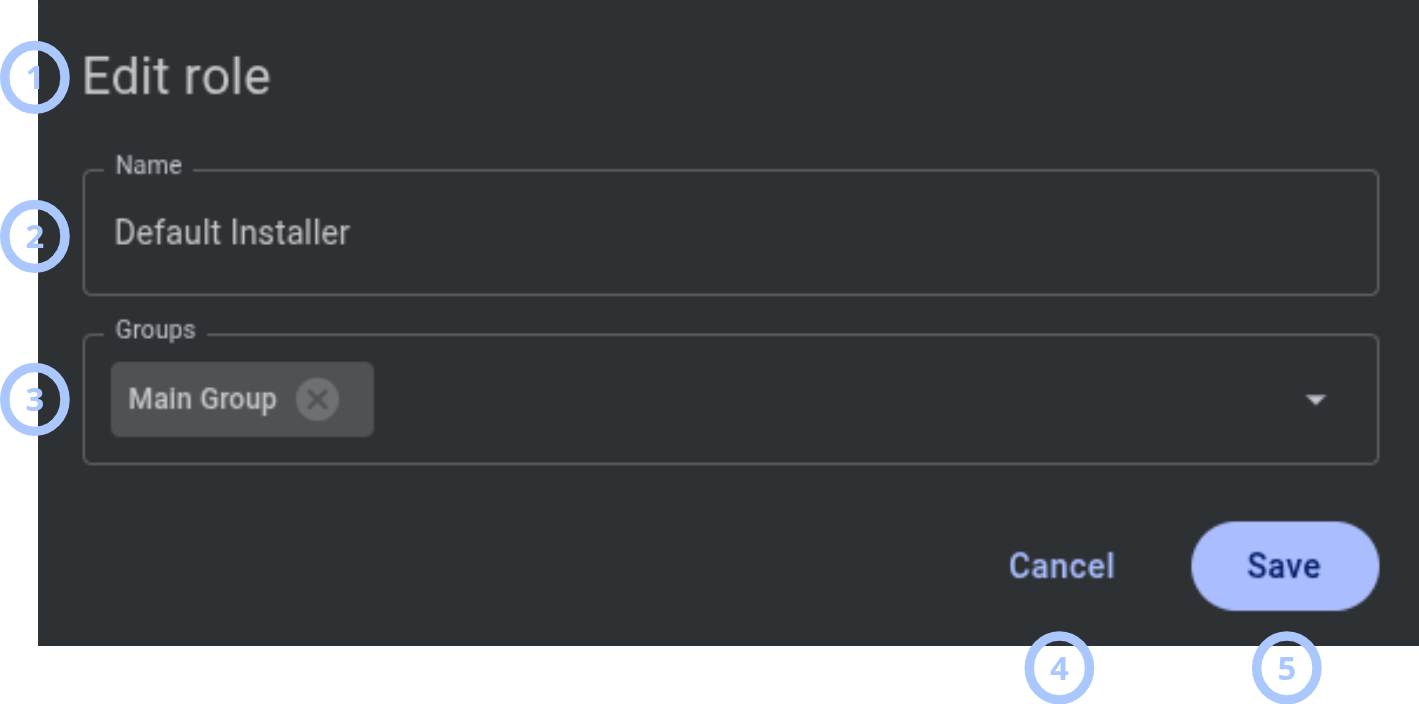
The Edit role modal opens when you select Edit role from the row actions menu.
| Callout | UI element | Description | When to use |
|---|---|---|---|
| 1 | Modal title | Shows the modal name: Edit role. | Use to confirm that you are editing role details. |
| 2 | Name field | Shows the current role name and allows edits. | Use to rename the role. |
| 3 | Groups dropdown | Shows the current assigned groups and allows changes. | Use to add or remove group assignments. |
| 4 | Cancel button | Closes the modal without saving. | Use when you do not want to keep changes. |
| 5 | Save button | Saves the changes when all values are valid. | Use after updating role details. |
Edit role permissions modal
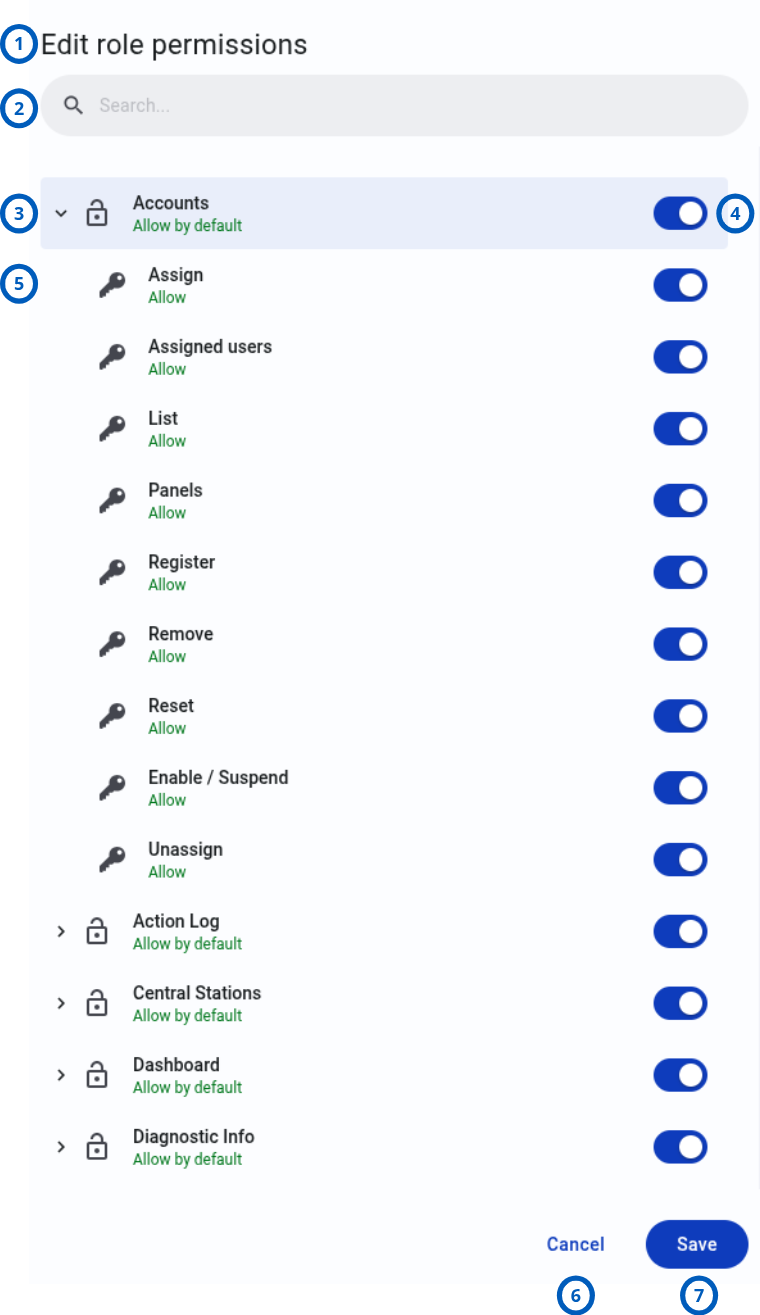
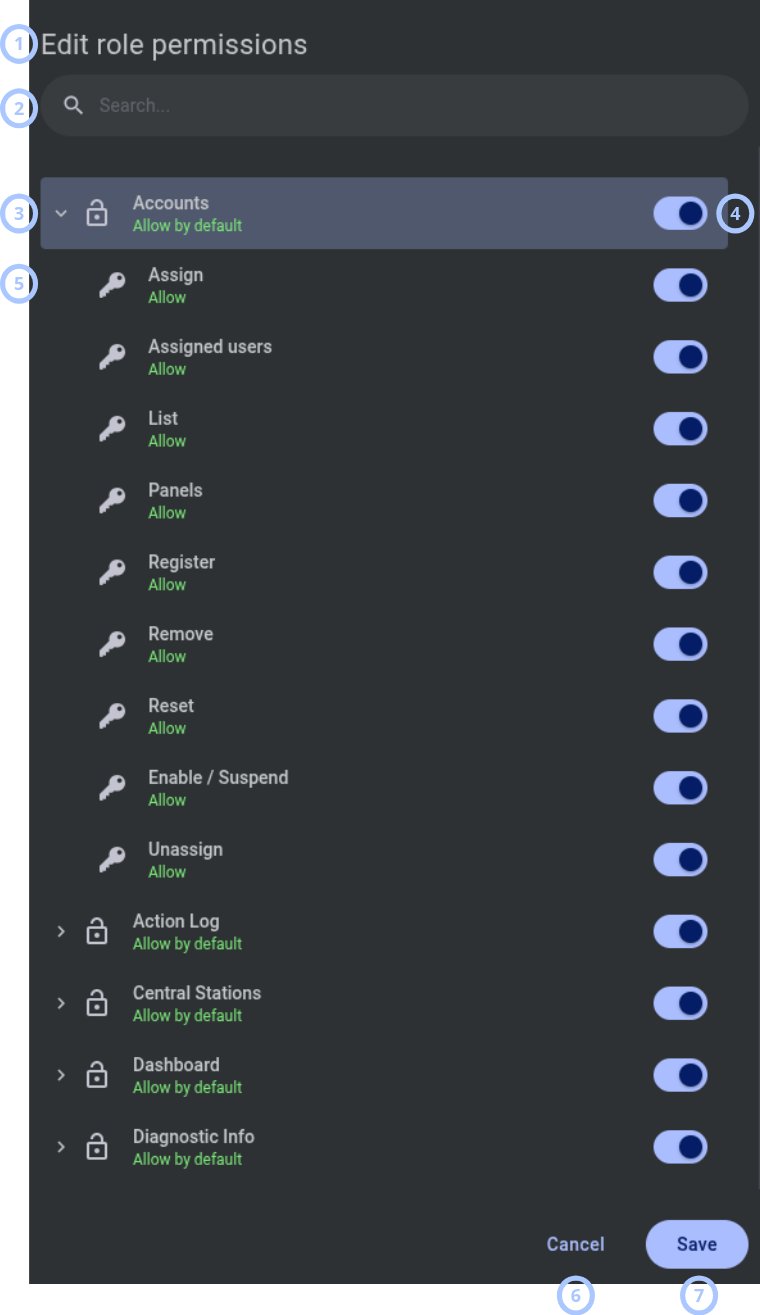
The Edit role permissions modal is divided into a permission search area, permission groups, permission controls, and action buttons.
| Callout | UI element | Description | When to use |
|---|---|---|---|
| 1 | Modal window name | Shows the modal name: Edit role permissions. | Use to confirm that you are editing permissions for the selected role. |
| 2 | Search field | Searches permissions by name. | Use to find a specific permission or permission group quickly. |
| 3 | Permission group | Shows a permission category, such as Accounts, Groups, Units, Roles, or Server Settings. | Use to review permissions by functional area. |
| 4 | Toggle | Enables or disables a permission or permission group. | Use to set the related permission to Allow or Deny. |
| 5 | Permission | Shows an individual permission inside a permission group. | Use to control access to a specific page, action, tab, widget, or API operation. |
| 6 | Cancel button | Closes the modal without saving changes. | Use when you do not want to apply permission changes. |
| 7 | Save button | Saves the permission changes for the role. | Use after reviewing all changed permissions. |
Edit self-registration settings modal
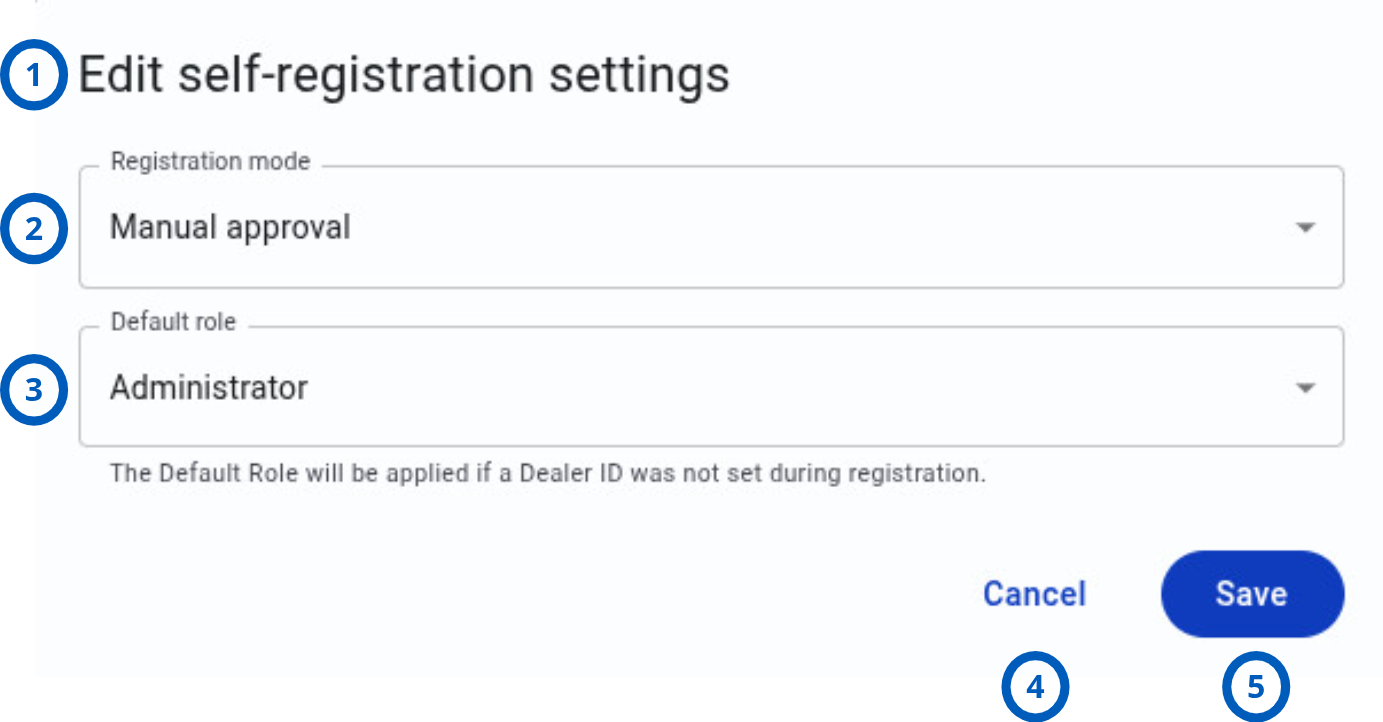
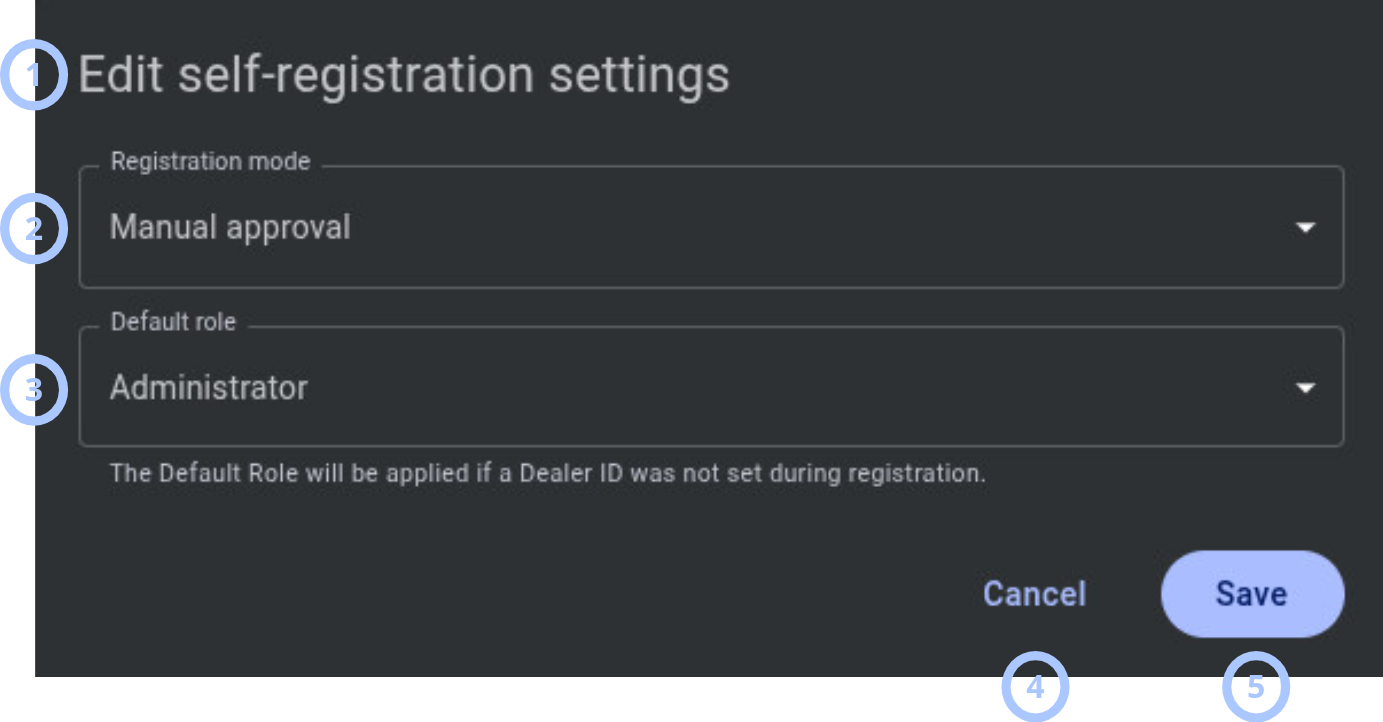
The Edit self-registration settings modal opens when you select Set role as default from the row actions menu.
| Callout | UI element | Description | When to use |
|---|---|---|---|
| 1 | Modal title | Shows the modal name: Edit self-registration settings. | Use to confirm that you are changing registration settings. |
| 2 | Registration mode dropdown | Controls how self-registration requests are handled. | Use to select Manual approval, Automatic approval, or Disabled. |
| 3 | Default role dropdown | Shows the current role and allows another role to be selected. | Use to choose which role is assigned during registration. |
| 4 | Cancel button | Closes the modal without saving. | Use when you do not want to change registration settings. |
| 5 | Save button | Saves the self-registration settings. | Use to set the selected role as the default registration role. |
Remove role modal
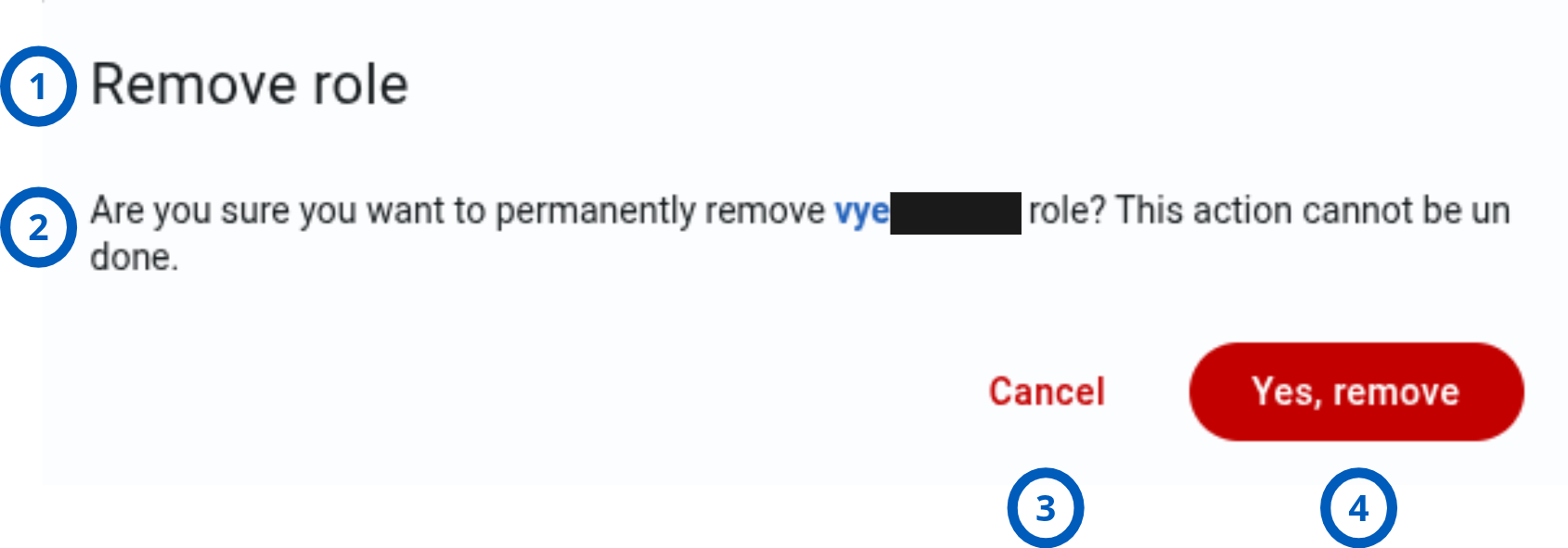
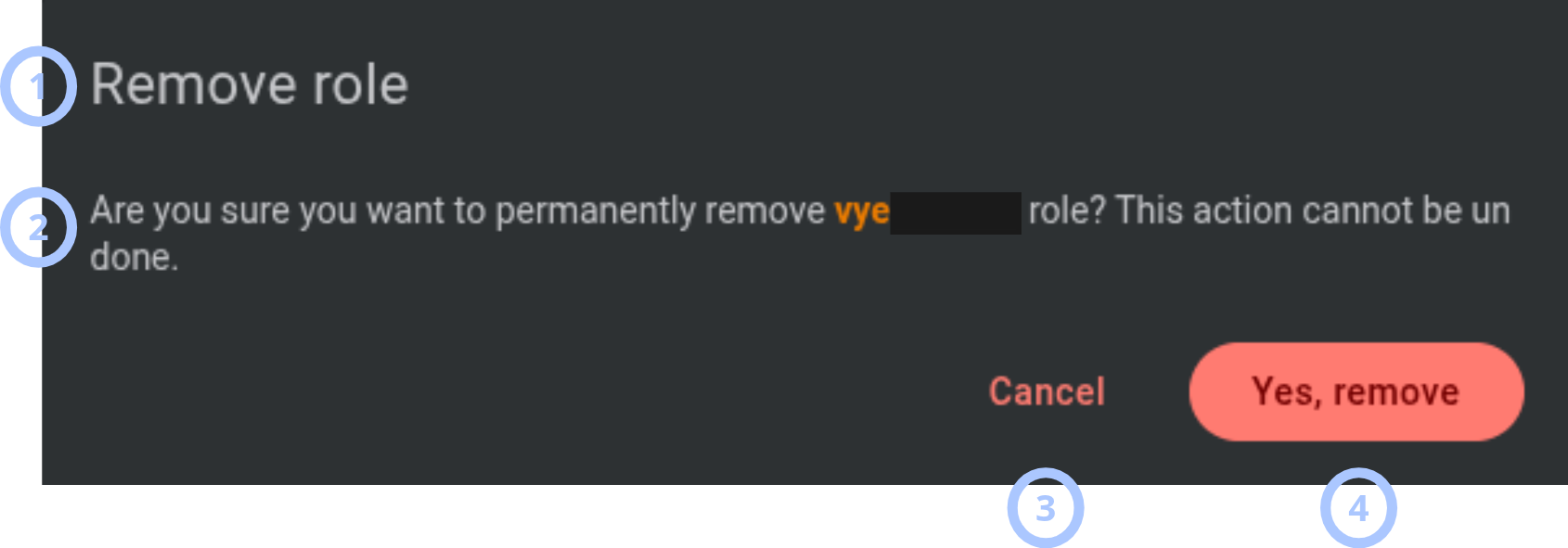
The Remove role modal opens when you select Remove from the row actions menu or the bulk action button.
| Callout | UI element | Description | When to use |
|---|---|---|---|
| 1 | Modal title | Shows the modal name: Remove role. | Use to confirm that you are removing a role. |
| 2 | Warning message | Shows the message: Are you sure you want to permanently remove role name role? This action cannot be undone. | Review before removing the role. |
| 3 | Cancel button | Closes the modal without removing the role. | Use when you do not want to remove the role. |
| 4 | Yes, remove button | Permanently removes the role when removal is allowed. | Use only when the role is no longer needed. |
Pagination controls


Pagination controls appear at the bottom of the roles grid.
| Callout | UI element | Description | When to use |
|---|---|---|---|
| 1 | Previous and next arrows | Move between pages in the roles grid. | Use when the role list has more records than the current page can show. |
| 2 | Range indicator | Shows the current range and total number of roles, for example, 1-15 of 25. | Use to understand where you are in the role list. |
| 3 | Roles per page selector | Controls how many roles appear on one page. Available values are 10, 15, 50, 100, and 200. | Use to change the grid page size. |
How to use this page
Create a role
Goal:
- Create a role, set its parent role, and assign groups.
Steps:
- Open the Roles page.
- Select the + add icon in the page header.
- In the Create role modal, enter a value in the Name field.
- Select a parent role from the Belongs to role dropdown.
- Select one or more groups from the Groups dropdown.
- Select Save.
Expected result:
- The role is created.
- The role appears in the roles grid.
- The Parent and Statistics columns show the relevant values.
Edit a role
Goal:
- Change a role name or update its assigned groups.
Steps:
- Open the Roles page.
- Find the role in the grid.
- Select the three vertical dots menu for the role.
- Select Edit role.
- In the Edit role modal, update the Name field or Groups dropdown.
- Select Save.
Expected result:
- The role is updated.
- The roles grid shows the latest role name and statistics.
Edit role permissions
Goal:
- Enable or disable permission groups and individual permissions for a role.
Steps:
- Open the Roles page.
- Find the role in the grid.
- Select the three vertical dots menu for the role.
- Select Edit permissions.
- In the Edit role permissions modal, use the search bar to find a permission group or permission.
- Expand a permission group to review its permissions.
- Use the toggle next to a permission group or permission to enable or disable it.
- Review the selected permissions before you close the modal.
Expected result:
- The role permissions are updated according to the selected toggles.
- Users assigned to the role receive access based on the enabled permissions.
Review permission changes before closing the modal. Permission changes can affect access for all employees assigned to the role.
Set a role as the default registration role
Goal:
- Configure which role is assigned during self-registration.
Steps:
- Open the Roles page.
- Find a role that is not already marked as the default registration role.
- Select the three vertical dots menu for the role.
- Select Set role as default.
- In the Edit self-registration settings modal, select a Registration mode:
- Manual approval
- Automatic approval
- Disabled
- Review the Default role dropdown. Change the selected role if needed.
- Select Save.
Expected result:
- The selected role is set as the default registration role.
- The role is marked with a check icon in the Role column.
Remove a role
Goal:
- Permanently remove a role that is no longer needed.
Steps:
- Open the Roles page.
- Find the role in the grid.
- Review the Statistics column for assigned employees and child roles.
- Select the three vertical dots menu for the role.
- Select Remove.
- In the Remove role modal, review the warning message.
- Select Yes, remove.
Expected result:
- The role is removed.
- The role no longer appears in the roles grid.
This action cannot be undone. A role cannot be removed while it has assigned employees or child roles.
Remove selected roles
Goal:
- Remove one or more selected roles from the grid.
Steps:
- Open the Roles page.
- Select the checkbox for each role you want to remove.
- Select Remove in the page header.
- Review the remove confirmation message.
- Confirm the removal.
Expected result:
- Roles that can be removed are deleted.
- Roles with assigned employees or child roles are not removed until those dependencies are cleared.
Review role statistics
Goal:
- Check group assignments, employee assignments, and child roles before editing or removal.
Steps:
- Open the Roles page.
- Find the role in the grid.
- Review the Statistics column.
- Hover over the assigned groups count to view group names.
- Hover over the assigned employees count to view the assigned employee count.
- Hover over the child roles count to view the child role count.
Expected result:
- The tooltip shows additional information about the selected statistic.
- You can decide whether the role can be safely edited or removed.
Change the number of roles shown per page
Goal:
- Change how many roles appear in the grid.
Steps:
- Go to the bottom-right area of the roles grid.
- Open the roles per page selector.
- Select one of the available values:
- 10
- 15
- 50
- 100
- 200
Expected result:
- The grid updates to show the selected number of roles per page.
- The range indicator updates.
Move between role pages
Goal:
- Navigate through multiple pages of roles.
Steps:
- Go to the bottom-left area of the roles grid.
- Select the next arrow to move forward.
- Select the previous arrow to move back.
- Review the range indicator, for example, 1-15 of 25.
Expected result:
- The grid shows the selected page of roles.
- The range indicator updates.
Field and option reference
Create role fields
| Name | Description | Accepted values | Behavior | Restrictions | Default value |
|---|---|---|---|---|---|
| Name | Role name. | Text. | Identifies the role in the roles grid and dropdown lists. | Must contain fewer than 255 characters. | Empty. |
| Belongs to role | Parent role for the new role. | Existing role from the dropdown list. | Sets the role hierarchy. | A parent role must be available. | Not specified. |
| Groups | Groups assigned to the role. | One or more existing groups. | Updates the assigned groups count in the statistics column. | Only available groups can be selected. | Empty. |
Edit role fields
| Name | Description | Accepted values | Behavior | Restrictions | Default value |
|---|---|---|---|---|---|
| Name | Current role name. | Text. | Updates the role name after saving. | Must contain fewer than 255 characters. | Current role name. |
| Groups | Current groups assigned to the role. | One or more existing groups. | Adds or removes group assignments after saving. | Only available groups can be selected. | Current assigned groups. |
Roles grid columns
| Name | Description | Accepted values | Behavior | Restrictions | Default value |
|---|---|---|---|---|---|
| Checkbox | Selects roles for bulk removal. | Selected or not selected. | Shows the Remove button in the page header. | Removal is blocked for roles with assigned employees or child roles. | Not selected. |
| Role | Role name and role type. | Saved role name and type, such as Default, Dealer, or Installer. | Shows a check icon when the role is the default registration role. | Read-only in the grid. | Not applicable. |
| Parent | Parent role assigned to the role. | Existing role name. | Shows the role hierarchy. | Read-only in the grid. | Depends on role configuration. |
| Statistics | Counts assigned groups, assigned employees, and child roles. | Numbers. | Shows tooltips with group names, assigned employee count, and child role count. | Read-only in the grid. | 0 where no related records exist. |
| Creator | Employee who created the role. | Employee name. | Supports audit and ownership review. | Read-only in the grid. | Set when the role is created. |
Predefined roles
| Name | Description | Accepted values | Behavior | Restrictions | Default value |
|---|---|---|---|---|---|
| Administrator | Built-in role with all permissions. | Not applicable. | Provides full access to all available permission groups and permissions. | Use only for users who require full administrative access. | Predefined. |
| Event Interface User | Built-in role for Event Interface access. | Not applicable. | Has only Event Interface group permissions. | Use for users who work with Event Interface features. | Predefined. |
| Default Installer | Built-in role for installer application access. | Not applicable. | Provides permissions similar to the legacy installer role. | Use for installer application access. | Predefined. |
| Operator | Built-in role for limited PowerManage control access. | Not applicable. | Provides limited control permissions. | Use for users who need restricted operational access. | Predefined. |
Self-registration settings
| Name | Description | Accepted values | Behavior | Restrictions | Default value |
|---|---|---|---|---|---|
| Registration mode | Controls how self-registration is handled. | Manual approval, Automatic approval, Disabled. | Determines whether registration requires approval, is approved automatically, or is unavailable. | Changing this setting affects future registrations. | Not specified. |
| Default role | Role assigned during registration. | Existing role from the dropdown list. | Marks the selected role with a check icon in the roles grid. | Only one role can be the default registration role. | Current default role. |
Pagination options
| Name | Description | Accepted values | Behavior | Restrictions | Default value |
|---|---|---|---|---|---|
| Roles per page | Controls how many roles appear on one page. | 10, 15, 50, 100, 200. | Updates the grid page size. | Large page sizes may require more scrolling. | 15. |
| Range indicator | Shows the current visible range and total count. | System-generated value, for example, 1-15 of 25. | Updates when you change page or page size. | Read-only. | Depends on total role count. |
Sub-dealer role creation behavior
When a sub-dealer is created on the server, two roles appear in the roles grid.
| Name | Description | Accepted values | Behavior | Restrictions | Default value |
|---|---|---|---|---|---|
| sub-dealer name Dealer | Dealer role created for the sub-dealer. | Generated role name. | Uses Administrator as the parent. Statistics show the assigned sub-dealer group, 1 employee, and 1 child role. | Depends on sub-dealer creation. | Generated when the sub-dealer is created. |
| sub-dealer name Installer | Installer role created for the sub-dealer. | Generated role name. | Uses sub-dealer name Dealer as the parent. Statistics show the assigned sub-dealer group, 0 employees, and 0 child roles. | Depends on sub-dealer creation. | Generated when the sub-dealer is created. |
Tips
- Review the Statistics column before removing a role. Roles with assigned employees or child roles cannot be removed.
- Use clear role names that describe the user's responsibility or access level.
- Use the permission search bar when you know the permission name or group name.
- Assign the fewest permissions required for the role's work.
- Review the default registration role after changing self-registration settings.
- Use pagination page size 50, 100, or 200 when reviewing a large number of roles.
Troubleshooting
Role cannot be created
Possible causes
- The Name field is empty.
- The role name contains 255 or more characters.
- A required dropdown value is missing.
- The current user does not have permission to add roles.
What to do
- Confirm that the Name field is completed.
- Make sure the role name contains fewer than 255 characters.
- Select a value in Belongs to role.
- Select required groups if group assignment is required by your configuration.
- Confirm that you have permission to add roles.
- Try saving again.
Role cannot be edited
Possible causes
- The role name is invalid.
- A selected group is no longer available.
- The current user does not have permission to edit roles.
What to do
- Open the Edit role modal again.
- Confirm that the Name field contains fewer than 255 characters.
- Review the selected groups.
- Confirm that you have permission to edit roles.
- Select Save again.
Permission changes are not available
Possible causes
- The current user does not have permission to edit role permissions.
- The permission group is collapsed.
- The search term filters out the expected permission.
What to do
- Confirm that you have permission to edit role permissions.
- Clear the search bar.
- Expand the relevant permission group.
- Use the toggle next to the required permission.
Role cannot be removed
Possible causes
- The role has one or more child roles.
- The role has one or more assigned employees.
- The current user does not have permission to remove roles.
What to do
- Review the Statistics column for the role.
- Hover over the child role count to confirm whether child roles exist.
- Remove or reassign child roles.
- Unassign employees from the role.
- Confirm that you have permission to remove roles.
- Try removing the role again.
Wrong role is set as the default registration role
Possible causes
- The wrong role was selected in the Default role dropdown.
- Registration settings were changed from another session.
What to do
- Open the Roles page.
- Find the role that should be the default registration role.
- Select the three vertical dots menu.
- Select Set role as default.
- In the Edit self-registration settings modal, confirm the Registration mode and Default role values.
- Select Save.
Expected role is missing from the grid
Possible causes
- The role is on another page of the grid.
- The page size is too small to show all roles.
- The role was removed.
- The current user does not have permission to view the role.
What to do
- Use the pagination arrows to move through the roles grid.
- Increase the roles per page value.
- Confirm that the role was not removed.
- Confirm that you have permission to list roles.